

 Leadership in service and working with nations with different leadership styles is a crucial aspect of international cooperation.
However, the challenge lies in bridging the gap between different leadership styles and approaches. Each nation has its own cultural and organizational context, which can influence their leadership practices.
To overcome this challenge, leaders must have a deep understanding of different leadership styles and be adaptable in their approach.
And the question, how does one find consensus from different countries in NATO because each nation has its own priorities.
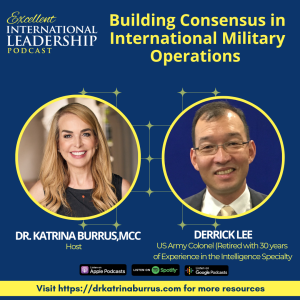
Derrick Lee, a military/army officer with 30 years of experience in the intelligence specialty, with extensive experience in multinational,coalition,alliance operational environments, having led both US and allied military service members. Two combat deployments, to Iraq and Afghanistan, and experience in NATO as well as Republic of Korea/US Combined Forces Command.
Well, let’s deep dive with Derrick Lee about his extensive military experience and his experience in multinational alliance operation and how consensus reached us at all.
What You’ll Learn From This Episode
- Discover the complexities of aligning diverse national interests within NATO to achieve common goals.
- Explore the shift in leadership styles as you progress up the ranks, from a focus on internal operations to strategic oversight.
- Learn how guiding and leading your teams to cultivate strong relationships, not just vertically but also horizontally, can enhance team dynamics and performance.
Derrick Lee on managing different levels of the organization:
“As you go up, the ratio of down and in versus up and out shifts. Down and in means you’re focused within your organization and you’re really kind of being closely involved. Up and out means you’re interacting more with your higher headquarters, you’re interacting more with your adjacent organization, and really kind of looking at the greater strategic picture.”
Topics Covered:
- 01:23 – Introduction to Derrick Lee’s background in military intelligence, focusing on analyzing threat situations.
- 05:14 – Discussion on monitoring Russian military activity in 2021 and the process of determining potential threats and future actions.
- 08:00 – Challenges of building consensus within NATO due to different national priorities and threats perceived by countries bordering Russia.
- 10:50 – Importance of explaining the strategic context behind orders to enhance team understanding and initiative.
- 13:00 – Managing different levels of the organization, emphasizing the shift from focusing within the organization to overseeing strategic contexts.
- 15:46 – Learning from various leadership styles and experiences to adapt to different levels of responsibility within the military.
- 18:54 – Transition to working in defense contracting, highlighting the importance of understanding financial aspects and budget execution for operational success.
Connect with Derrick Lee
Connect with Katrina Burrus
- LinkedIn: https://www.linkedin.com/in/katrinaburrus/
- Facebook: https://www.facebook.com/katrina.burrus
- Twitter: https://twitter.com/katrinaburrus?lang=en
- More Impactful Episodes at https://mkbconseil.ch/eil-podcast/
Here are lessons that can be beneficial to an international leader:
- Building Consensus: One key lesson for an international leader is the importance of building consensus among diverse team members from different nations. This involves listening to different viewpoints, understanding national priorities, and fostering open discussions to reach a common understanding and agreement.
- Strategic Thinking: Another valuable lesson is the need for international leaders to think strategically and consider the broader context of their organization’s mission. This includes looking beyond immediate tasks and focusing on long-term goals, understanding geopolitical threats, and adapting strategies accordingly.
- Effective Communication: International leaders should prioritize effective communication to ensure clarity, understanding, and alignment among team members from various backgrounds. Explaining the rationale behind decisions, providing context, and encouraging proactive thinking can enhance team cohesion and performance.
From Military Intelligence to Defense Contracting: A Leadership Journey
Introduction
In this episode, we delve into the fascinating journey of Derrick Lee, a seasoned professional with over 30 years of experience in military intelligence. From analyzing threat situations to leading intelligence programs in defense contracting, Derrick’s career trajectory offers valuable insights into effective leadership strategies and the transition from military to civilian roles.
Military Intelligence: Analyzing Threats
Derrick’s background in military intelligence involved analyzing potential threats and adversaries to ensure mission success. By collecting and synthesizing information, he was able to determine likely courses of action from adversaries, such as Russia’s military activities near Ukraine in 2021.
Challenges in NATO Operations
During his time at NATO Allied Land Command, Derrick faced the challenge of building consensus among personnel from 28 allied and partner nations. Balancing national interests and priorities while focusing on common goals, particularly in the face of threats like Russia, required effective communication and strategic decision-making.
Leadership at Different Levels
Derrick’s leadership style evolved as he moved up the ranks, from a company commander overseeing 60 personnel to managing larger organizations with thousands of personnel. The shift from a focus on internal operations to a broader strategic perspective highlighted the importance of delegation and collaboration across different levels of the organization.
Building Consensus and Proactive Teams
By explaining the rationale behind orders and decisions, Derrick emphasized the importance of building consensus and empowering team members to be proactive in their roles. Encouraging open dialogue and considering diverse viewpoints contributed to mission success and team cohesion.
Transition to Defense Contracting
In his current role as a director of an intelligence program in defense contracting, Derrick leverages his military experience to provide valuable insights from the client’s perspective. By understanding client requirements and streamlining processes, he enhances support services and expertise for government agencies.
Lessons Learned and Personal Growth
Reflecting on his career, Derrick acknowledges the importance of continuous learning and expanding his knowledge beyond his core expertise. While excelling in military intelligence, he now recognizes the value of understanding financial aspects and budget execution for effective organizational management.
Conclusion
Derrick Lee’s leadership journey from military intelligence to defense contracting exemplifies the adaptability and strategic acumen required in dynamic environments. By navigating complex challenges, building consensus, and embracing continuous learning, Derrick’s experiences offer valuable lessons for aspiring leaders in both military and civilian sectors. His story underscores the importance of effective communication, proactive decision-making, and a holistic approach to leadership development.